

There's a stubborn belief in sales operations that inbound and outbound calling must live in separate silos, staffed by separate teams, running on separate systems. It feels logical on the surface. But this separation quietly kills agent utilization, slows lead response times, and leaves money on the table every single day. Call blending challenges that assumption directly. When you align your inbound and outbound workflows under one intelligent system, you unlock a level of efficiency and lead engagement that siloed teams simply cannot match. This article breaks down exactly how that works and what you can do about it starting now.
Table of Contents
- What is call blending and why does it matter?
- How call blending works: Architectures and service plans
- Managing priorities: When inbound and outbound calls compete
- Best practices for maximizing lead engagement with call blending
- Why most SMEs underuse call blending—and what actually works
- Turn insights into results with smarter call blending
- Frequently asked questions
Key Takeaways
| Point | Details |
|---|---|
| Blending boosts efficiency | Combining inbound and outbound calls keeps agents busier and maximizes your call center output. |
| Priorities matter | Systems should prioritize urgent inbound calls to maintain high customer satisfaction and service levels. |
| Optimize with data | Regularly analyze blended calling reports to improve scheduling and maximize lead engagement. |
| Blending fits all sizes | Both large centers and small teams can benefit from call blending—technology makes it accessible. |
What is call blending and why does it matter?
Call blending is the process of enabling agents to handle both inbound and outbound calls dynamically, based on real-time demand signals rather than rigid pre-assignment. Instead of locking an agent into purely answering calls or purely dialing out, a blended system routes work to whoever is available and best suited at that exact moment.
For SMEs running lean sales teams, this is a significant operational shift. Think about a typical outbound campaign: your agents are dialing leads, but between connections there's dead time. Meanwhile, a customer calls in and waits in a queue. In a siloed setup, your outbound agents sit idle while inbound agents scramble. In a blended setup, the system recognizes the inbound demand and routes that call to an available outbound agent automatically.
The mechanics rely on service level controls and work queues. As Oracle docs describe, Oracle Interaction Blending delivers media to agents assigned to contact channels according to service levels set in the service plan. That means the system is constantly evaluating queue depth, agent availability, and priority rules to make smart routing decisions in real time. This isn't a manual process. It's automated intelligence working in the background.
Key operational advantages of call blending for SMEs:
- Higher agent utilization: Agents spend more time on live conversations and less time waiting for the next task.
- Faster lead response: Outbound agents can pivot to handle warm inbound leads the moment they arrive, cutting response time dramatically.
- Reduced staffing costs: You need fewer agents to cover the same volume because each agent handles a broader range of work.
- Smoother customer experience: Callers wait less. Leads get contacted faster. Both sides of the interaction improve simultaneously.
- Better campaign flexibility: Managers can shift agent focus between inbound and outbound based on campaign performance without reassigning staff.
Pro Tip: If your outbound agents regularly experience more than 15 minutes of idle time per hour, that's your signal to evaluate a call blending overview system. You're leaving productivity on the floor every shift.
The business case is straightforward. Blending isn't a luxury for enterprise call centers. It's a practical efficiency tool that any SME running more than a handful of agents can benefit from immediately.
How call blending works: Architectures and service plans
Understanding the mechanics of call blending helps you make smarter decisions about system configuration and staffing. At the core of any blended architecture is the concept of work selectors and queues. These are the routing rules that determine which call goes to which agent at any given moment.
When a call enters the system, whether inbound or outbound, it gets classified and placed into a queue. The work selector then evaluates which agents are available, what their current service plan allows, and what the priority level of the call is. Only then does the system make an assignment. This happens in milliseconds, but the logic behind it is what separates effective blending from chaotic routing.
Oracle's service plan framework provides a useful model for understanding the two primary service plan types in a blended environment:
| Service plan type | Primary function | Agent assignment focus | Typical use case |
|---|---|---|---|
| Inbound service plan | Manages incoming call routing | Routes to available agents by skill or availability | Customer support, warm lead intake |
| Outbound service plan | Controls outbound dialing campaigns | Assigns agents to active dial lists and queues | Lead outreach, follow-up campaigns |
In a blended environment, agents can be assigned to both plan types simultaneously. The system shifts their active assignment based on which queue needs attention most urgently.
Here's how media distribution works in a blended system, step by step:
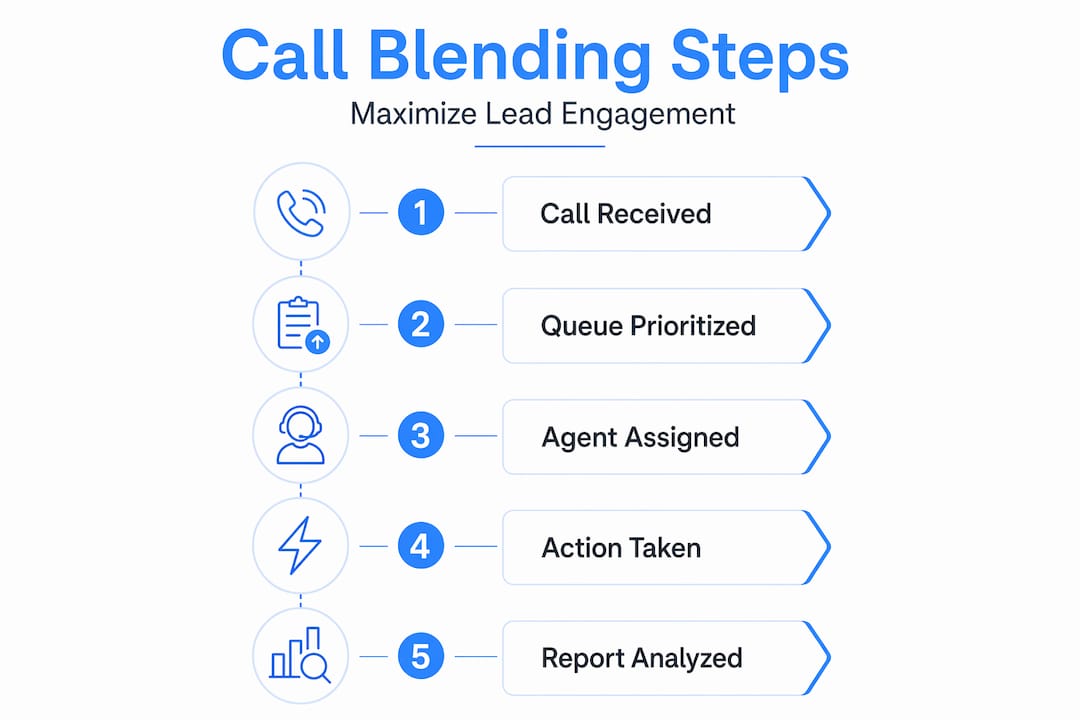
- A call enters the system (inbound from a customer or outbound from a campaign dialer).
- The system classifies the call type and assigns it to the appropriate queue.
- The work selector scans available agents and checks their current service plan assignments.
- Priority rules are applied: urgent calls are elevated, routine retries are held if higher-priority work exists.
- The call is delivered to the best available agent based on the service level targets set in the active plan.
- After the call ends, the agent is returned to the queue and the cycle repeats.
This loop runs continuously throughout a shift. The impact on staffing is real and measurable. Teams that implement blended architectures consistently report that they can handle higher call volumes without proportional headcount increases. That's not a small win for an SME managing tight margins.
One important detail: blending doesn't mean agents are constantly switching modes mid-call. The system manages transitions between tasks during natural breaks, like after a call ends or when an agent completes a wrap-up task. The experience for agents is smoother than it sounds, especially with proper training and a well-configured system.

Managing priorities: When inbound and outbound calls compete
Here's where call blending gets genuinely interesting and where most teams either get it right or fall apart. What happens when an urgent inbound call arrives at the exact moment an agent is about to dial an outbound lead? Which one wins?
Imagine this scenario: your team is running a high-priority outbound campaign targeting warm leads from last week's webinar. Agents are queued up and ready to dial. At the same time, a customer who purchased your product six months ago calls in with a billing issue. That call is urgent. It has real service implications. Your system needs to make a smart decision fast.
Industry standard: Urgent inbound calls take precedence over routine outbound retries. When both types of work are present in the queue, a properly configured blended system will always route the urgent inbound call first, holding the outbound retry for when capacity is available.
This priority logic is not just a technical setting. It reflects a core business principle: protecting the customer relationship takes priority over prospecting. Sprinklr's priority-based blending framework makes this explicit, emphasizing that urgent inbound calls are prioritized over routine outbound retries in a well-designed blended system.
Here's how different scenarios play out in a priority-based blended environment:
| Scenario | Inbound status | Outbound status | System action |
|---|---|---|---|
| Normal operations | Low inbound volume | Active outbound campaign | Agents focus on outbound; inbound routed as it arrives |
| Inbound spike | High inbound volume | Outbound campaign running | System pulls agents from outbound to cover inbound queue |
| Urgent inbound | Critical customer issue | Routine outbound retry | Urgent inbound routed immediately; retry held in queue |
| Balanced load | Moderate inbound | Moderate outbound | System distributes based on service level targets |
The call blending benefits of getting this priority logic right are substantial. Your lead engagement rates stay strong during normal operations, while your service quality remains protected during inbound spikes. You're not sacrificing one for the other. You're managing both intelligently.
The key for sales and marketing leaders is to configure these priority rules intentionally, not just accept default settings. Default configurations are generic. Your business has specific peak hours, specific campaign schedules, and specific customer service commitments. Your blending rules should reflect all of that.
Best practices for maximizing lead engagement with call blending
Knowing how blending works is one thing. Squeezing every bit of value out of it is another. Here are the practices that consistently separate high-performing blended teams from average ones.
Tactics to maximize lead engagement through call blending:
- Dial leads within the first five minutes of inbound interest. When a lead submits a form or responds to an email, the window for connection is narrow. A blended system can immediately route that warm lead to the next available agent, whether they were just finishing an outbound call or wrapping up an inbound inquiry.
- Balance agent workload by tracking blending ratios. Monitor how much time each agent spends on inbound versus outbound tasks daily. Imbalances signal misconfigured service plans or staffing gaps that need correction.
- Reduce wait times by setting inbound thresholds. Configure your system to pull outbound agents into the inbound queue when wait times exceed a set threshold, such as 45 seconds. This keeps customer experience intact without permanently disrupting your outbound campaign.
- Improve follow-up rates with smart retry scheduling. When an outbound call goes unanswered, don't just retry randomly. Schedule retries based on time-of-day data from previous successful connections. Your blended system should support this kind of rule-based retry logic.
- Use wrap-up time strategically. The brief period after a call ends is when agents update notes and prepare for the next task. Configure your system to use this window to pre-queue the next call, so agents move from conversation to conversation with minimal idle time.
Monitoring for inbound spikes is critical during active outbound campaigns. Sprinklr's blending data reinforces that systems designed for priority-based blending actively monitor queue conditions and adjust agent assignments in real time, which means your outbound campaign doesn't have to stop when inbound volume rises. It just adapts.
Pro Tip: Pull your call blending reports every Monday morning and look at three numbers: average inbound wait time, outbound connect rate, and agent idle time. If any of these are trending in the wrong direction, your service plan configurations likely need adjustment. Consistent monitoring is what separates teams that use blending well from those that just have it turned on. Platforms built for efficient call handling make this kind of reporting accessible without needing a data analyst on staff.
Why most SMEs underuse call blending—and what actually works
Here's the uncomfortable truth we've seen play out repeatedly: most small and mid-sized businesses that invest in a blended calling system end up using only a fraction of its capability. They turn it on, run a few campaigns, and never revisit the configuration. The system runs, but it doesn't perform.
The common assumption is that call blending is a large call center technology. Something for enterprises with hundreds of agents and dedicated operations teams. That belief is wrong, and it's costing SMEs real revenue. A team of six agents running a blended system correctly will consistently outperform a team of ten running siloed operations. The math is that clear.
But the technology is only part of the equation. The teams that get the most from blending share three characteristics. First, they align their KPIs to blending outcomes. They don't just track total calls made. They track connect rates by call type, lead outcome rates by blending strategy, and service level adherence across both inbound and outbound queues. Second, they train agents specifically for blended work. Moving between inbound and outbound calls requires a different mental posture than doing one or the other all day. Agents need to know how to shift tone and intent quickly. Rigid scripts that work for pure outbound often fall flat when an agent suddenly has to handle a customer service inquiry.
Third, and most importantly, they review their blending strategy lessons monthly. Not quarterly. Monthly. Call patterns change. Campaign goals shift. Lead quality fluctuates. A blending configuration that worked perfectly in January may be underperforming by March if nobody checks it. The teams that win with blending treat it as an ongoing practice, not a one-time setup.
The hardest lesson we've learned is that underperformance in blended environments is almost never a technology problem. It's a process and attention problem. The system will do exactly what you configure it to do. If you configure it thoughtfully and review it regularly, it will deliver. If you set it and forget it, you'll wonder why your results are mediocre.
Turn insights into results with smarter call blending
You now understand how call blending works, why priority logic matters, and what separates teams that thrive with it from those that struggle. The next step is putting that knowledge into a system that actually executes it.
DialerSeat is built for exactly this kind of outbound and blended calling work. At $35 per week with no contracts or setup fees, it gives sales teams and call centers the tools to run multiple campaigns simultaneously, skip voicemails automatically, and track every lead outcome across campaigns. The platform supports smarter call blending through intuitive campaign management, real-time tracking, and a setup process that gets your team dialing within hours, not weeks. If you're ready to stop leaving agent productivity on the floor and start engaging more leads with the team you already have, DialerSeat is the platform to start with.
Frequently asked questions
How does call blending improve agent productivity?
Call blending keeps agents engaged by dynamically routing the most important calls based on service level controls, which reduces idle time between tasks and maximizes the number of meaningful conversations per shift.
What happens when both inbound and outbound calls are waiting?
Most systems prioritize urgent inbound calls over routine outbound retries, as Sprinklr's blending framework confirms, ensuring service levels are protected without permanently halting outbound campaigns.
Is call blending suitable for small teams?
Yes, even teams as small as four to six agents can benefit significantly from blending because it increases the output of each individual agent rather than requiring additional headcount to handle mixed call volumes.
What are the first steps to implement call blending?
Start by mapping your inbound traffic patterns across different times of day, then select a platform that supports flexible agent assignment and configurable service level controls so your routing rules match your actual business needs.
How often should you review your call blending configuration?
Review your blending setup at least once a month, checking connect rates, idle time, and inbound wait times to catch configuration drift before it starts affecting lead engagement and customer service quality.