

Outbound sales teams pour real money into lead generation campaigns, and most of that money leaks through the same handful of holes. The common lead generation campaign mistakes covered here are not obscure edge cases. They are the errors that show up in call centers, sales teams, and agencies every quarter, quietly draining budgets and flattening conversion rates. If your pipeline feels inconsistent or your cost per qualified lead keeps climbing, the problem is almost certainly one of the patterns below. Here is how to identify them, fix them, and stop losing ground to teams that already have.
Table of Contents
- Casting your net too wide: why targeting everyone misses the mark
- Slowing down kills deals: mastering rapid follow-up for outbound calling
- When marketing and sales don't speak the same language: fixing the handoff
- Measuring what matters: avoiding vanity metrics that mask pipeline health
- Mind the funnel fit: aligning conversion experiences with buyer readiness
- Avoiding dependency: the power of multichannel outreach in outbound lead generation
- Comparison of common lead generation mistakes and their impact on campaigns
- Why fixing lead generation mistakes demands operational discipline, not just marketing magic
- How DialerSeat helps you avoid lead generation pitfalls and accelerate sales
- Frequently asked questions
Key Takeaways
| Point | Details |
|---|---|
| Target narrowly | Focus your campaigns on a well-defined ideal customer profile to ensure messaging resonates and outreach is efficient. |
| Respond quickly | Follow up with leads within five minutes to maximize qualification and conversion likelihood. |
| Align sales and marketing | Agree on shared lead definitions and provide rich engagement context in handoffs to improve lead quality and sales efficiency. |
| Measure outcomes | Track KPIs tied to pipeline and revenue, avoiding vanity metrics that do not influence decision-making. |
| Use multichannel outreach | Combine phone, email, and social to diversify lead acquisition and reduce reliance on a single channel. |
Casting your net too wide: why targeting everyone misses the mark
The most persistent of all common lead generation campaign mistakes is also the most invisible. When you target broadly, every individual metric looks fine. Call volume is up. Email open rates are acceptable. The problem surfaces later, when almost none of those contacts convert.
Overly broad targeting produces low-intent leads and wastes outreach effort because your messaging cannot be specific enough to resonate with anyone in particular. A script written for "any business with more than 10 employees" will feel generic to every single person who hears it.
The fix is a tightly defined ideal customer profile (ICP). That means specifying:
- Company size by headcount and revenue range
- Industry vertical and sub-sector
- Decision-maker role and typical reporting structure
- Triggering conditions such as recent funding, hiring surges, or technology changes
Focused targeting does not shrink your opportunity. It concentrates your effort where win probability is highest, which directly improves pipeline quality and reduces wasted dials.
Slowing down kills deals: mastering rapid follow-up for outbound calling
Speed is not a nice-to-have in outbound lead generation. It is the single biggest operational variable you can control. Responding within 5 minutes makes a lead 21 times more likely to qualify than waiting 30 minutes. That is not a marginal improvement. That is a category difference.

Most teams know this statistic and still fail to act on it because they lack the routing infrastructure to make fast follow-up automatic. Without a follow-up system, leads go to competitors who simply picked up the phone first.
To fix this, build the following into your outbound process:
- Live call queues that route inbound responses and callbacks to available agents immediately
- CRM automation that triggers a follow-up task the moment a lead is created or updated
- Service level agreements (SLAs) that define maximum acceptable response times by lead source and priority
- Multi-touch sequences that combine calls, voicemails, and emails within the first 24 hours
"The window for engaging a new lead is measured in minutes, not days. Every hour you wait, the probability of a live conversation drops sharply."
Pro Tip: Set your SLA at 5 minutes for high-intent leads and 60 minutes for all others. Review SLA adherence weekly, not monthly. Teams that review it monthly almost always discover they have been missing it for weeks.
When marketing and sales don't speak the same language: fixing the handoff
This is one of the most common sales funnel mistakes in organizations running outbound programs alongside inbound marketing. Marketing qualifies a lead and passes it over. Sales calls it unqualified. Both teams are right by their own definitions, and that is exactly the problem.
Misalignment on what "sales-ready" means and insufficient handoff context lead to wasted sales time and finger-pointing between teams. The lead falls through the gap while both sides argue about whose fault it is.
The practical solution requires four things:
- A shared MQL and SQL definition documented and agreed upon by both teams, reviewed quarterly
- Enriched handoff packages that include engagement history, content consumed, and the specific trigger that prompted the handoff
- Recommended talk tracks built around what the lead has already seen or heard, so the first call does not feel like starting from scratch
- Feedback loops where sales reports back on lead quality weekly so marketing can recalibrate lead scoring in real time
Pro Tip: Run a monthly 30-minute review where sales shares the three leads that wasted the most time and marketing shares the three leads that converted fastest. The patterns you find in those six examples will tell you more than any dashboard.
Measuring what matters: avoiding vanity metrics that mask pipeline health
Clicks. Downloads. Form fills. These numbers feel like progress because they go up. They are also some of the most misleading lead generation errors a team can make when they become the primary measure of campaign success.
Volume-based vanity metrics do not impact actual sales conversations or pipeline. A campaign that generates 500 downloads and zero qualified opportunities is a failed campaign, regardless of how good the download number looks in a slide deck.
The metrics that actually correlate with revenue are:
- Sales qualified lead (SQL) acceptance rate — what percentage of leads marketing passes does sales actually work
- Opportunity creation rate — how many SQLs become active opportunities
- Pipeline contribution by campaign — which specific campaigns are generating revenue, not just activity
- Contact-to-conversation rate — for outbound calling, how many dials result in a meaningful conversation
Segment all of these by ICP fit. A campaign generating 50 SQLs from your target profile outperforms one generating 200 SQLs from outside it every time.
Mind the funnel fit: aligning conversion experiences with buyer readiness
Asking someone who just learned your company exists to book a 45-minute demo is one of the most common advertising pitfalls in outbound lead generation. It feels efficient. It is actually a lead capture mistake that drops conversion rates at the most critical moment.
Premature demo requests and high-friction forms cause leads to disengage before they ever reach a sales conversation. The fix is matching your call-to-action to where the buyer actually is in their journey.
Build your funnel with stage-appropriate offers:
- Awareness stage: Short educational content, a single question survey, or a low-commitment resource download
- Interest stage: A brief discovery call, a specific use-case webinar, or a comparison guide
- Decision stage: A demo, a trial, or a direct pricing conversation
Keep landing pages focused on one audience and one purpose. Every additional field in your form reduces completion rates. Collect only what your sales team will actually use in the first call.
Pro Tip: Audit your highest-traffic landing pages and count the form fields. If you have more than four fields on a top-of-funnel page, you are almost certainly losing leads who would have converted with a shorter form.
Avoiding dependency: the power of multichannel outreach in outbound lead generation
Building your entire pipeline on one channel is a campaign performance issue waiting to happen. Single-channel dependence leads to stalled pipelines and ROI loss the moment that channel underperforms, whether due to algorithm changes, deliverability issues, or market saturation.
Effective lead generation tips consistently point to integrated multichannel sequences as the most reliable way to maintain consistent lead flow. The goal is not to be everywhere. It is to be present across the channels your specific buyers use, in a coordinated sequence.
A practical multichannel outbound sequence looks like this:
- Day 1: Personalized email introducing the value proposition
- Day 2: LinkedIn connection request with a brief, relevant note
- Day 3: Outbound call with a voicemail referencing the email
- Day 5: Follow-up email with a specific insight or resource
- Day 7: Second call attempt at a different time of day
Personalization across channels outperforms volume. One well-researched sequence targeting 50 ideal-fit contacts will outperform a generic blast to 500 marginal ones.
Comparison of common lead generation mistakes and their impact on campaigns
| Mistake | Root cause | Campaign impact | Recommended fix |
|---|---|---|---|
| Overly broad targeting | Undefined ICP | Low-intent leads, wasted dials | Define ICP by size, industry, and role |
| Slow follow-up | No routing or SLA system | Leads lost to competitors | Automate routing, enforce 5-minute SLA |
| Sales and marketing misalignment | No shared SQL definition | Leads rejected, finger-pointing | Agree on criteria, enrich handoff packages |
| Relying on vanity metrics | Wrong KPI selection | Misleading campaign performance data | Track SQL acceptance and opportunity creation |
| Funnel stage mismatch | Generic CTAs and forms | High drop-off before sales contact | Match CTA to buyer readiness stage |
| Single-channel dependence | No multichannel strategy | Pipeline volatility, ROI loss | Build coordinated email, phone, and social sequences |
Why fixing lead generation mistakes demands operational discipline, not just marketing magic
Here is the uncomfortable truth most lead generation advice skips: the mistakes above are not primarily messaging problems. They are infrastructure problems.
You can write the most compelling outbound script in your industry and still lose leads because your routing is manual, your SLA is aspirational rather than enforced, and your CRM does not automatically surface context when a rep picks up the phone. Lead scoring systems fail when platforms are disconnected and misaligned with territory and capacity planning, directly hurting ROI.
Most teams treat lead generation as a series of campaigns. The teams that consistently outperform treat it as a system. Campaigns are the inputs. The operational backbone is what determines whether those inputs produce revenue or noise.
What that backbone actually requires is less glamorous than most marketing conversations acknowledge. It means documented SLAs that someone is accountable for. It means a CRM that is actually maintained. It means a weekly feedback loop between sales and marketing that is not optional. It means routing logic that does not depend on a human remembering to assign a lead.
The irony is that most of the common lead generation campaign mistakes in this article are not solved by better creative or a bigger budget. They are solved by making the boring operational stuff work reliably. Teams that get that right will outperform teams with better messaging and bigger spend almost every time. Avoiding lead generation failures is, at its core, an operational discipline problem dressed up as a marketing problem.
How DialerSeat helps you avoid lead generation pitfalls and accelerate sales
Knowing the mistakes is only half the equation. The other half is having the infrastructure to prevent them at scale.
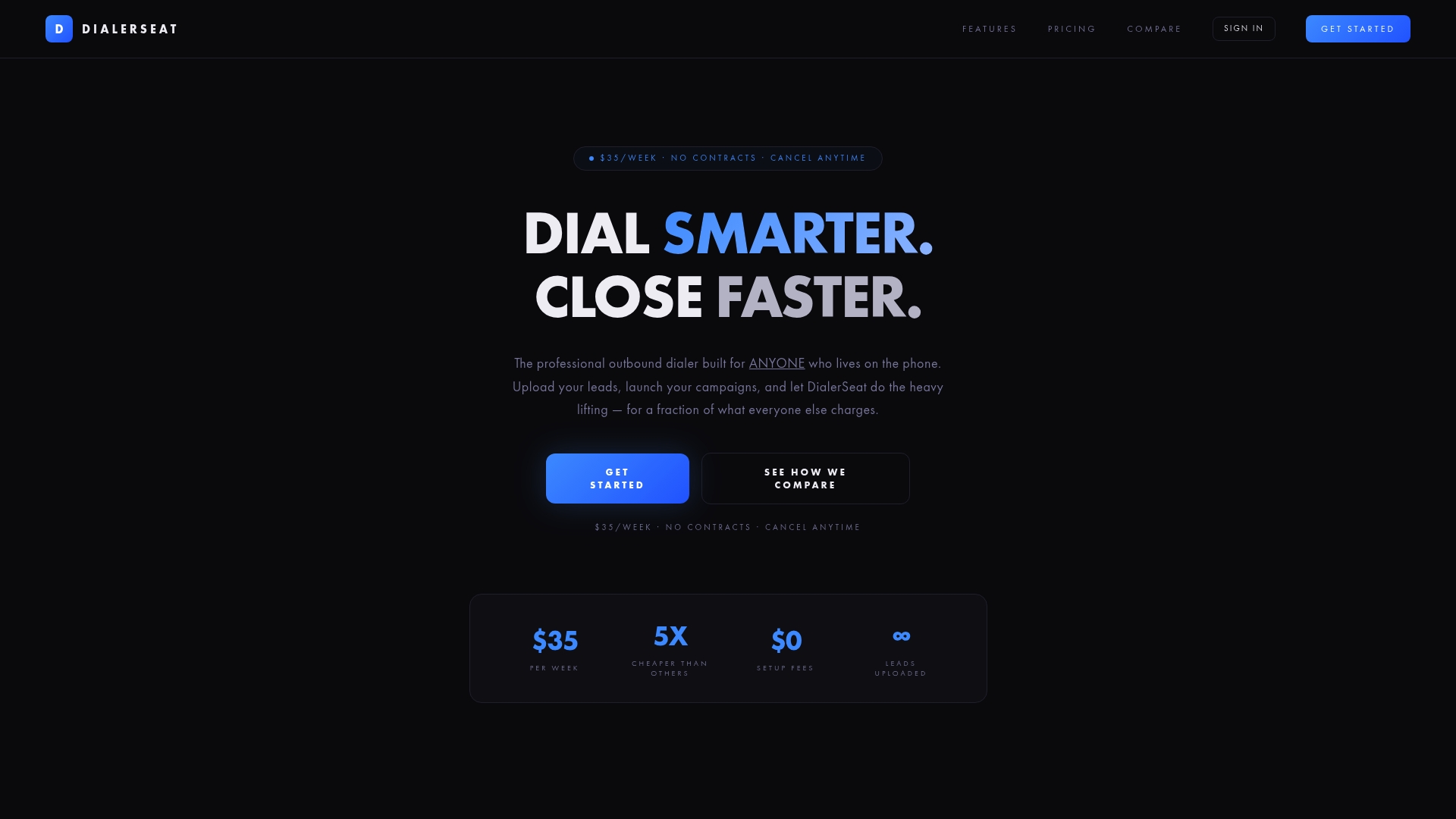
DialerSeat is built specifically for outbound calling teams that need to move fast, stay organized, and maintain consistent follow-up without adding headcount. The platform automates lead routing to live call queues, so your team reaches new leads within minutes rather than hours. Built-in campaign tracking gives you real visibility into contact rates and conversation quality, not just dial volume. At $35 per week with no contracts or setup fees, it removes the cost barrier that keeps smaller teams operating with manual processes. If you are serious about fixing the campaign performance issues that are costing you pipeline, DialerSeat gives your team the operational foundation to make it happen.
Frequently asked questions
What is the "5-minute rule" in lead response?
It means responding within 5 minutes makes a lead 21 times more likely to qualify than responding after 30 minutes, making speed the most controllable variable in outbound calling success.
Why is targeting too broadly a common lead generation mistake?
Because broad targeting produces low-intent leads and forces messaging to be so generic it resonates with no one, wasting both budget and rep time on contacts with poor fit.
How can sales and marketing alignment improve lead quality?
By agreeing on shared qualification criteria and transferring complete engagement context with every lead, teams eliminate the friction that causes qualified leads to be rejected or ignored at handoff.
What metrics should teams focus on to assess lead generation success?
Teams should prioritize SQL acceptance rates and opportunity creation over vanity metrics like clicks or downloads, since only pipeline-connected metrics reflect actual campaign performance.
Why is multichannel outreach important for outbound campaigns?
Because single-channel dependence creates pipeline volatility; when that channel underperforms, your entire lead flow stalls, while coordinated multichannel sequences maintain consistent engagement across buyer touchpoints.